Ferrari — the Models, the Production Numbers and the Signature of an Engineer
Why a Ferrari is called 250, 512 or Testarossa — the logic behind the names, the production numbers of the classics, and the story of a dark-blue 400i.
Units built (bars)
Fioravanti design
Ferrari 400i
1960s
1970s
1980s
1990s
2000s
2010s
2020s
The Logic Behind the Ferrari Names
Ferrari’s nomenclature looks arbitrary — but it isn’t. Over the decades it follows several successive logics. Once you know them, the name tells you engine and era at a glance.
250, 365, 400, 412
Early logic: the number is the displacement of a single cylinder in cc. A 250 has 250 cc × 12 cylinders ≈ 3.0 litres; a 365 (Daytona) 365 × 12 ≈ 4.4 litres; a 400 accordingly 4.8 litres.
308, 328, 288
New logic from the 1970s: total displacement + number of cylinders. A 308 = 3.0 litres, 8 cylinders; a 328 = 3.2 litres, 8 cylinders; the 288 GTO = 2.8 litres, 8 cylinders (turbo).
512 BB
The same new logic, lightly disguised: 5.0 litres, 12 cylinders — whereas its predecessor, the 365 GT4 BB, was still named by the old per-cylinder rule. This is where the most common confusion lies.
Names instead of numbers
Exceptions with meanings of their own: Testarossa (“red head” — the red-painted cam covers), Daytona (an unofficial nickname after the 1-2-3 win of 1967), F40 (40 years of Ferrari), later Enzo, LaFerrari, Roma.
Modern era
Mixed again: the 458 states 4.5 litres and 8 cylinders, the turbocharged 488 returns to the per-cylinder rule (488 cc × 8 ≈ 3.9 litres), the 812 states power (800 hp) and cylinder count.
In short: there is not one system but a sequence of systems. That is not sloppiness — it is the trace of an engineering culture grown over seventy years, in which the name should always reveal something about the machine.
From 36 to 12,000 — the Range of Production
The timeline above plots the production numbers of the classics between 1962 and 1995 (vertical axis, logarithmic — these orders of magnitude could not otherwise be shown together). The spread is enormous: from the 250 GTO, of which only 36 were built, to the 308, which reached about 12,000, lies more than two orders of magnitude.
Hover over a point — or wait a moment and the timeline runs through the models automatically: each shows production years, engine and units built. The white-filled points mark the designs of Leonardo Fioravanti; the dark-blue point is the 400i — which is up next.
The Ferrari 400i — and a Snowy Car Park in Davos
A masterpiece of restraint — and the car that, over forty years ago, showed me good form where I would never have expected it.
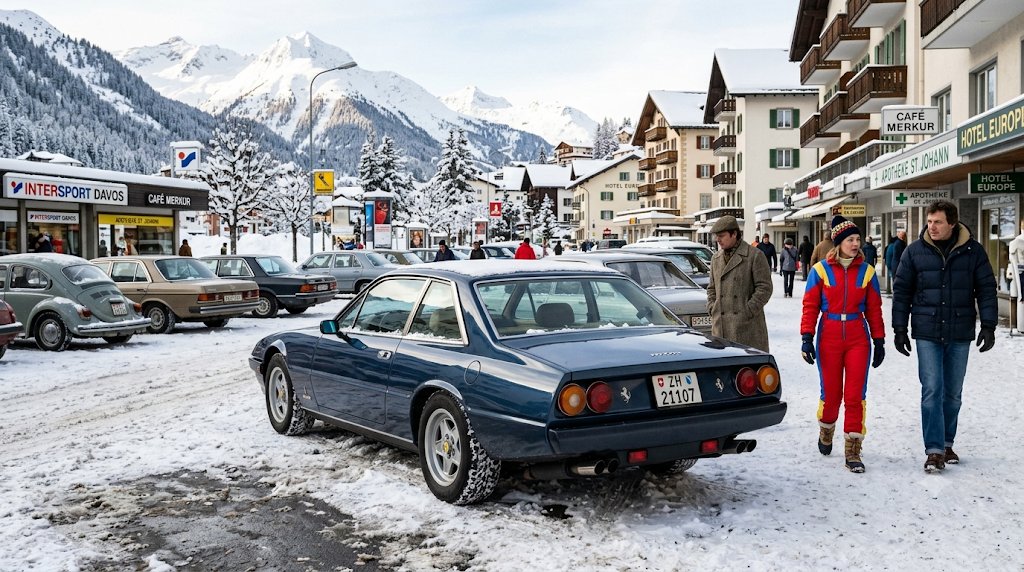
Davos, winter light: a dark-blue Ferrari 400, Zurich plates — the scene that burned itself into me exactly. Hover over the image to zoom.
Winter 1981, Davos. I was there with my mother; we were visiting my brother at the clinic in Wolfgang. The car park at Davos Platz lay under light snow, the light flat and grey, as it is in the mountains in January. And there it stood: a dark-blue Ferrari 400, Zurich plates. An inner earthquake I can still recall exactly today.
I was twenty. What struck me was not noise. It was the opposite. Dark blue is not a colour that shouts. This car wanted to prove nothing. I have rarely met that kind of composure since. Poise. It simply stood there, with a matter-of-factness I had until then granted only to the 911 or the old Jaguars. A blow — quiet and complete.
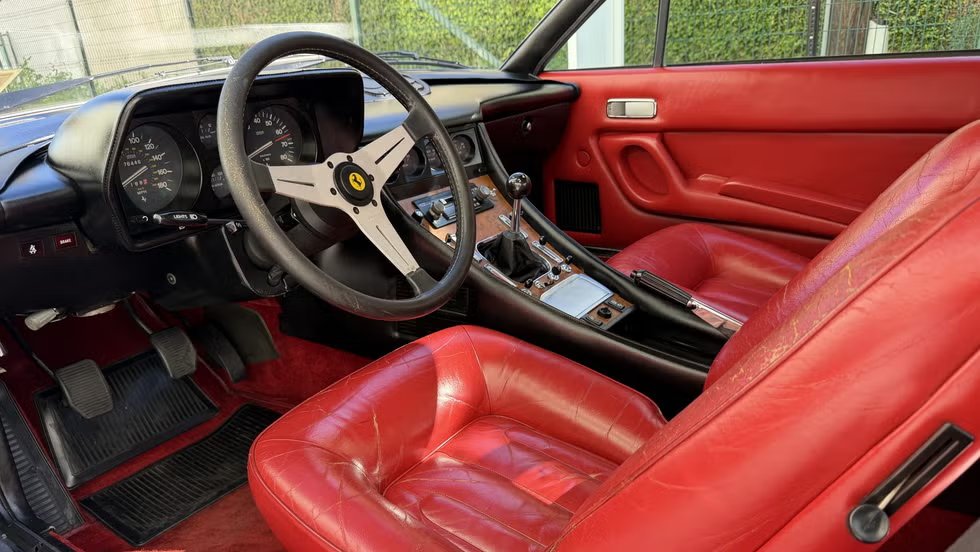
The interior of the 400i: leather, wood, clear instruments — grand tourer, not race car. Rigour down to the detail.
It took me a long time to understand why this car of all cars. I went on to become an industrial designer, trained in the tradition of HfG Ulm and the Bauhaus. That meant: form follows function. Honesty of construction. Distrust of anything that pretties itself up without working. A Ferrari, by that teaching, was a suspect case — unreasonable, extravagant, and under the skin probably an imposition.
The 400 put my own rules to the test. What form follows function demanded — reduction, proportion, calm — this car delivered, point for point. Three clear volumes, no ornament, not one line too many. No Italian pathos, but rigour. Good form, where I would never have expected it: in the brand that stands for “noise”.
I have often been to Davos since, and this image was always there first: the snow, the matte blue, the quiet elegance of this car, the emotional pull of the brand. Never faded.
Production years 400 / 400i
1976–1985
Units built
1,796
Distinction
1st Ferrari with fuel injection*
* The 400i (1979) was the first Ferrari road car with fuel injection; the 400 was also the first Ferrari ever with an automatic gearbox. The series 365 GT4 2+2 → 400 → 400i → 412 (1972–1989) remained the longest uninterrupted model line in the company’s history.
Modena, in High Summer — a Visit to the Museo Enzo Ferrari
Between myth and museum vitrine: what remains when you get very close to the red dream — and what is lost.
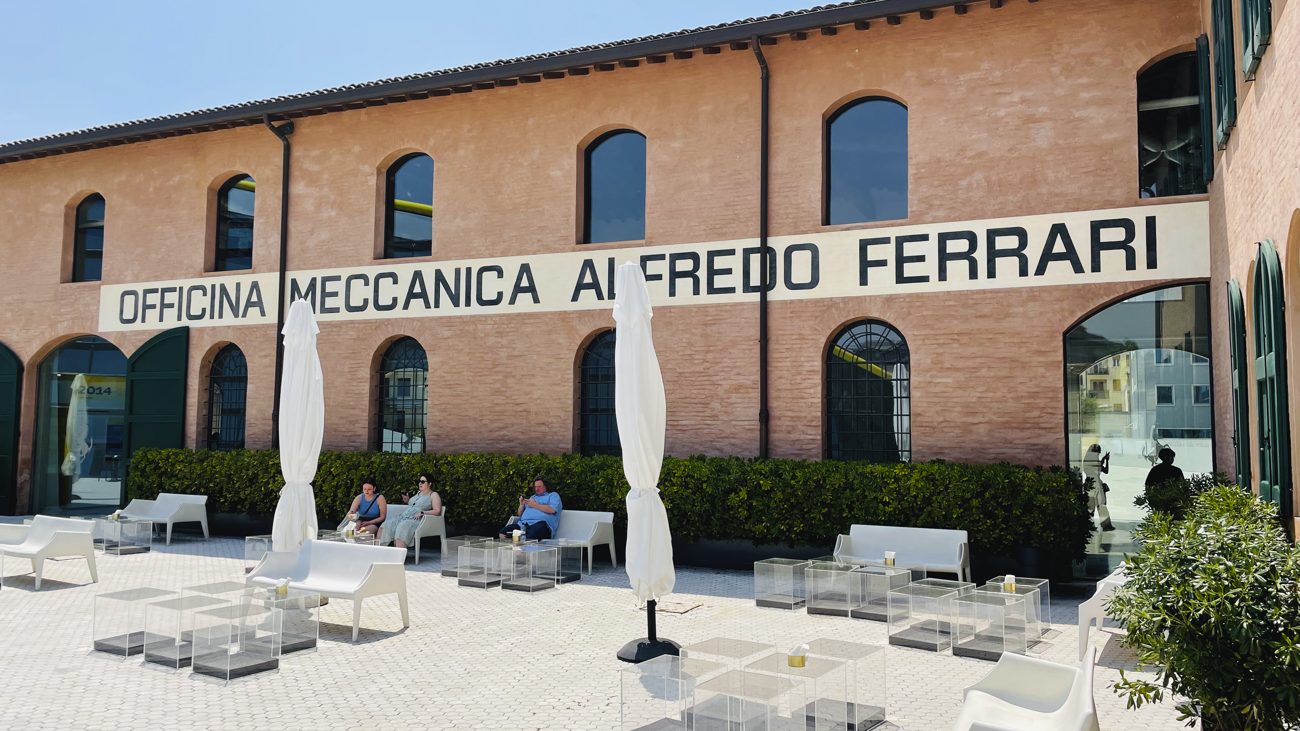
The Museo Enzo Ferrari in Modena, housed in the old Officina Meccanica Alfredo Ferrari — the workshop of Enzo’s father, right next to his birthplace. Hover over the images to zoom.
The Room That Explains Everything: Enzo’s Office
No stage, no marble. A desk, a telephone, a globe — and an indomitable will.
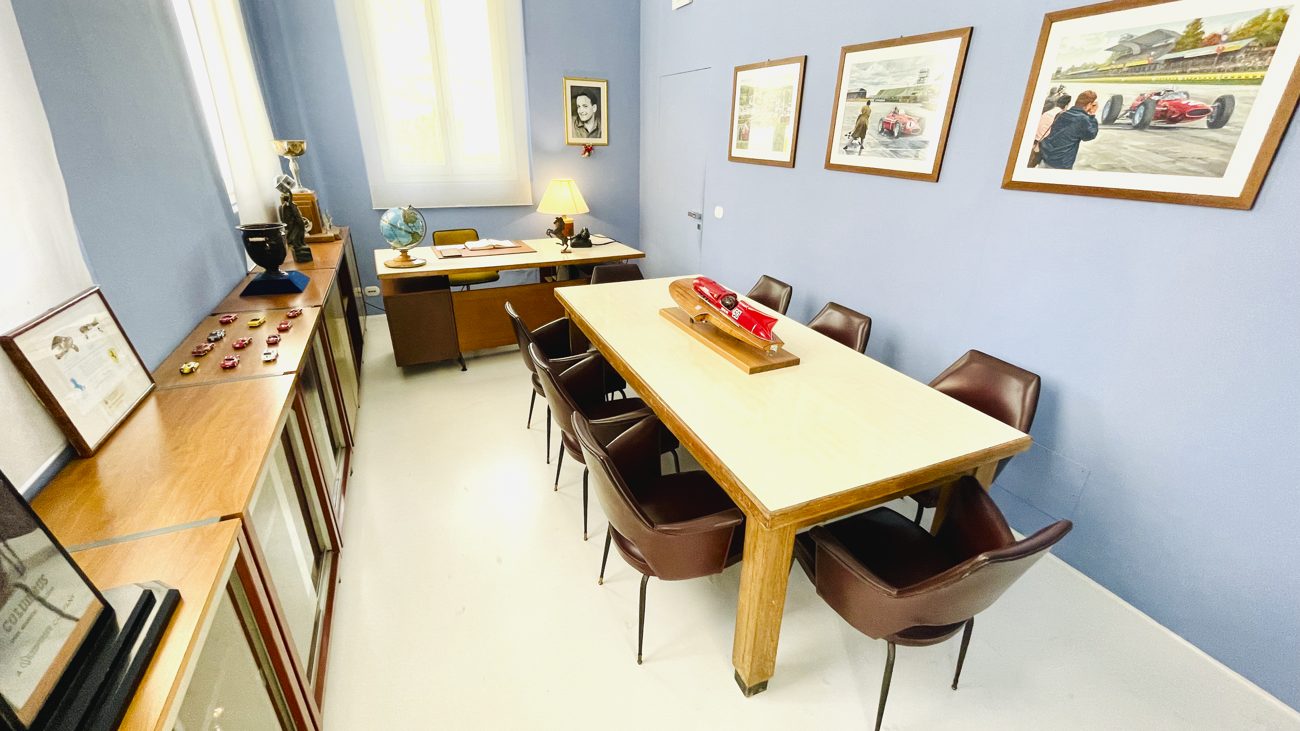
Of everything this museum shows, a single room truly moved me: the reconstruction of Enzo Ferrari’s office. And precisely because it is so incredibly plain. A simple desk, a few chairs with worn leather, a globe, an old telephone, on the wall a few framed racing scenes and the portrait of his son Dino, who died young. No glamour, no glory. Nothing in this room suggests that one of the strongest brands in the world was conceived here.
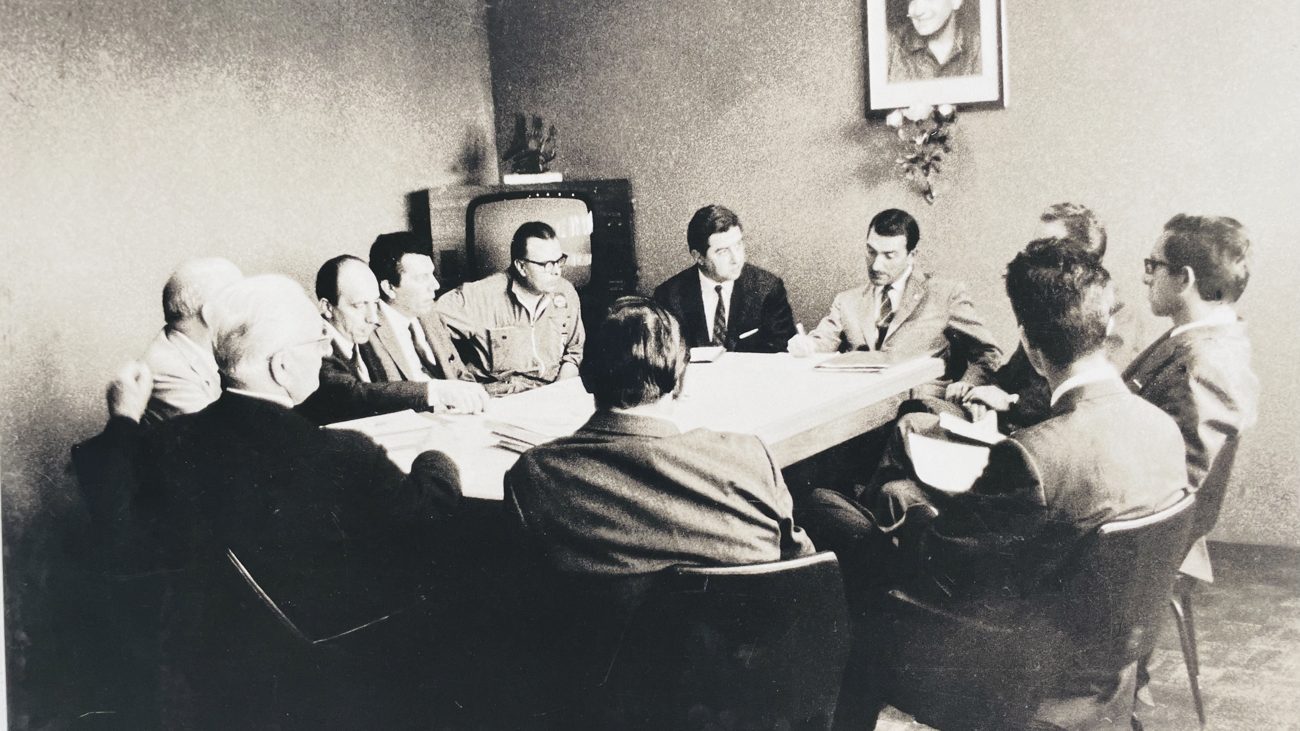
The reconstructed workroom: blue walls, a plain conference table, the portrait of Dino Ferrari. Out of this sobriety a world was bornmarke.
That is exactly where the lesson lies. What began here was no design vision and no marketing plan — it was entrepreneurial will in its purest form. A good idea, pursued stubbornly, without a safety net, without a façade. The Ferrari myth was not devised in a studio but in this bare room, at this table, in conversation with engineers and drivers. You stand before it and understand: the brand was first an attitude, long before it was a logo.
A meeting in the 1960s: engineers, drivers, a table. This is how history was made.
The Hall That Stays Silent
Many cars, much heat — and an order that refused to reveal itself to me.
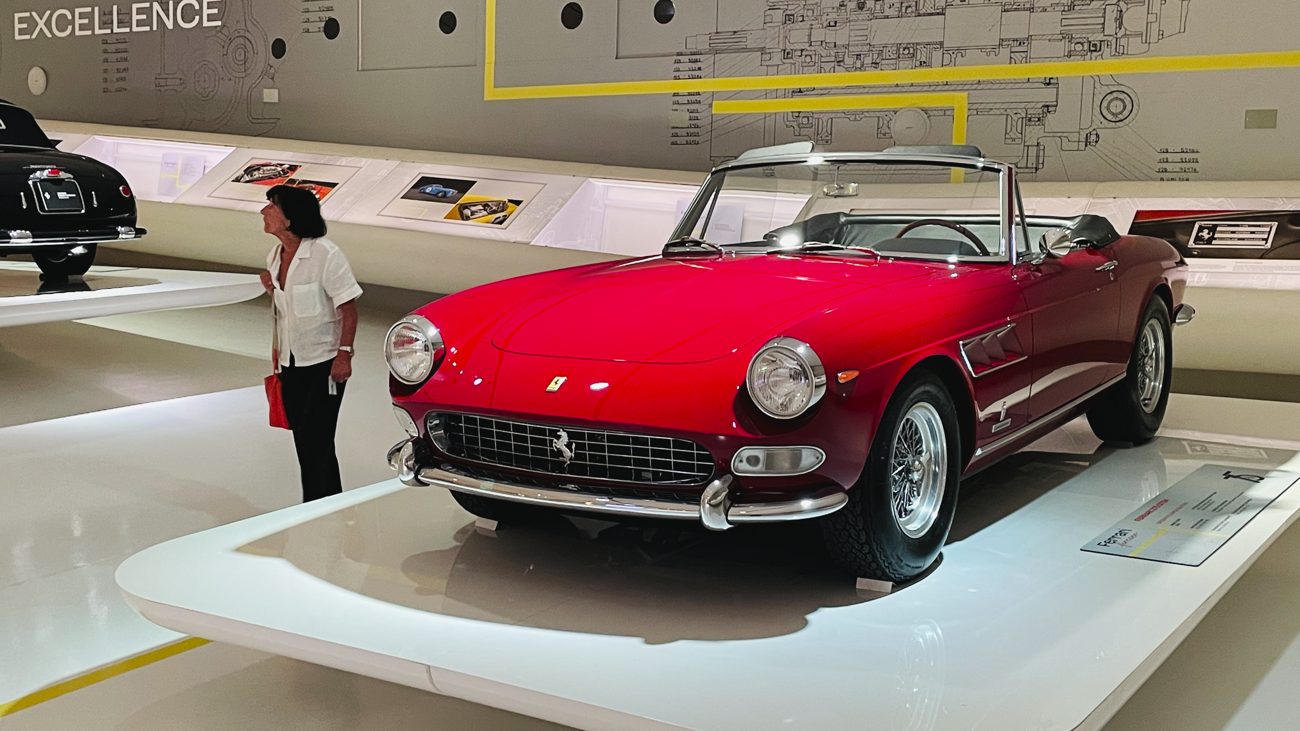
The “Excellence” hall: a 275 GTS, flawlessly staged — and yet strangely mute.
And then, honestly, the disappointment. The large exhibition hall with the models left me oddly cold. It was mighty hot that day, the cars stood flawless on their white plinths under sweeping ceiling arches — but the system and sequence did not reveal themselves to me. What logic connects these cars? What thread leads from one to the next? I could not find it. You wander past legends and yet feel no narrative. (Which is, incidentally, exactly the gap this page tries to close.)
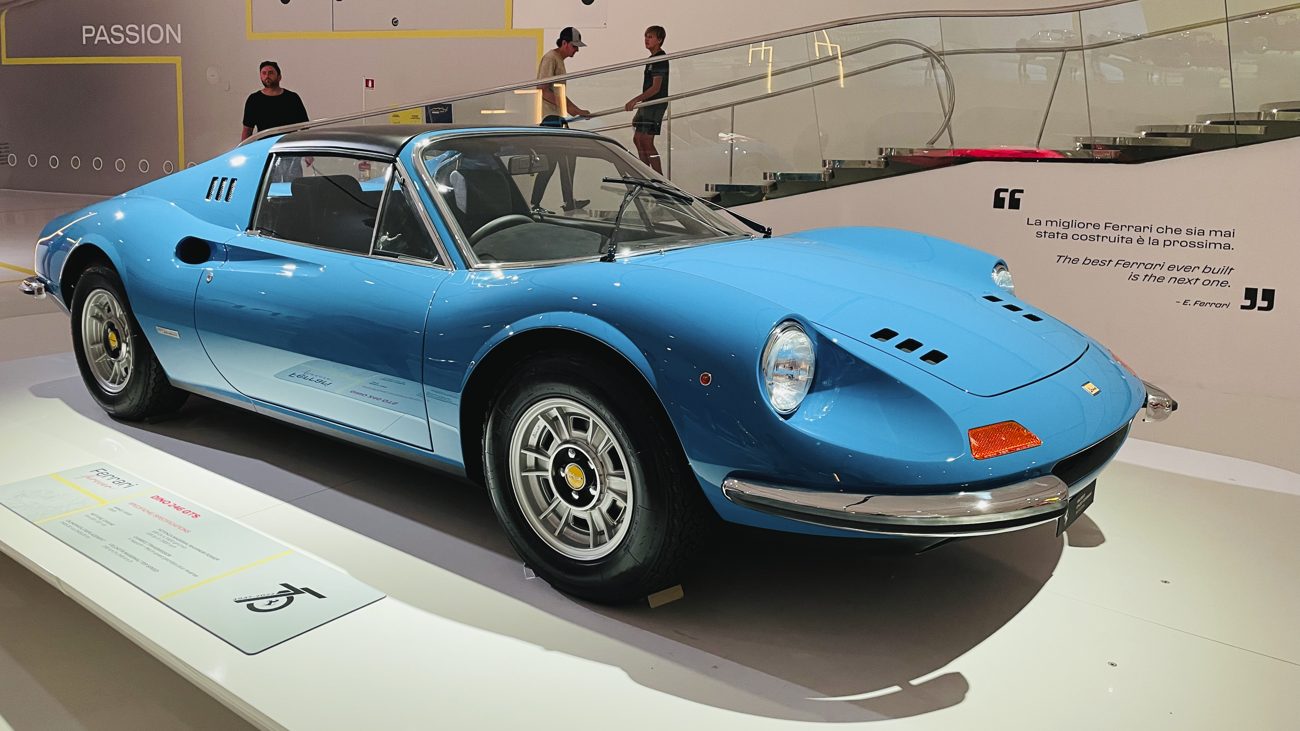
A Dino 246 GTS beneath Enzo’s motto: “The best Ferrari is always the next one.” A magnificent line — hardly redeemed in a museum.
Keyrings and the Missed Story
At the end the shop awaits. And with it a question that, as a communicator, would not let me go.
At the end, as always, the souvenir shop: keyrings, T-shirts, baseball caps. Nothing wrong with that — and yet the whole thing felt muddled, a jumble of relic and trinket, of great history and small merchandise. You leave the building with a peculiar feeling: moved by the office, at a loss before the hall.
Perhaps that is exactly what shows how hard it is to present the esprit of a brand in a museum — to translate the shine, the emotion, the unconditional will into rooms and routes without becoming kitschy or arbitrary. A genuine communication task was waiting here: to make an attitude tangible out of objects. Sadly no one really dared to take it on — you feel that in every hall. And honestly: it would have tempted me.
Leonardo Fioravanti — the Engineer Behind the Beauty
Only decades later did I understand whom I owe this impression to. The man was Leonardo Fioravanti, and he was no designer in the ordinary sense but a mechanical engineer. Born in Milan in 1938, he studied aerodynamics and body construction at the Politecnico di Milano — under Antonio Fessia, the engineer behind the great Lancias. In 1963 he graduated as an aerodynamics engineer.
In 1964, aged twenty-six, he joined Pininfarina and stayed twenty-four years. That is why his cars have this taut, almost architectural quality. It is not drawing — it is construction that turns, almost by accident, into beauty. In 1972 he became head of Pininfarina Studi e Ricerche, later managing director; in 1988 he moved to Ferrari as deputy general manager, and in 1991 he founded his own studio.
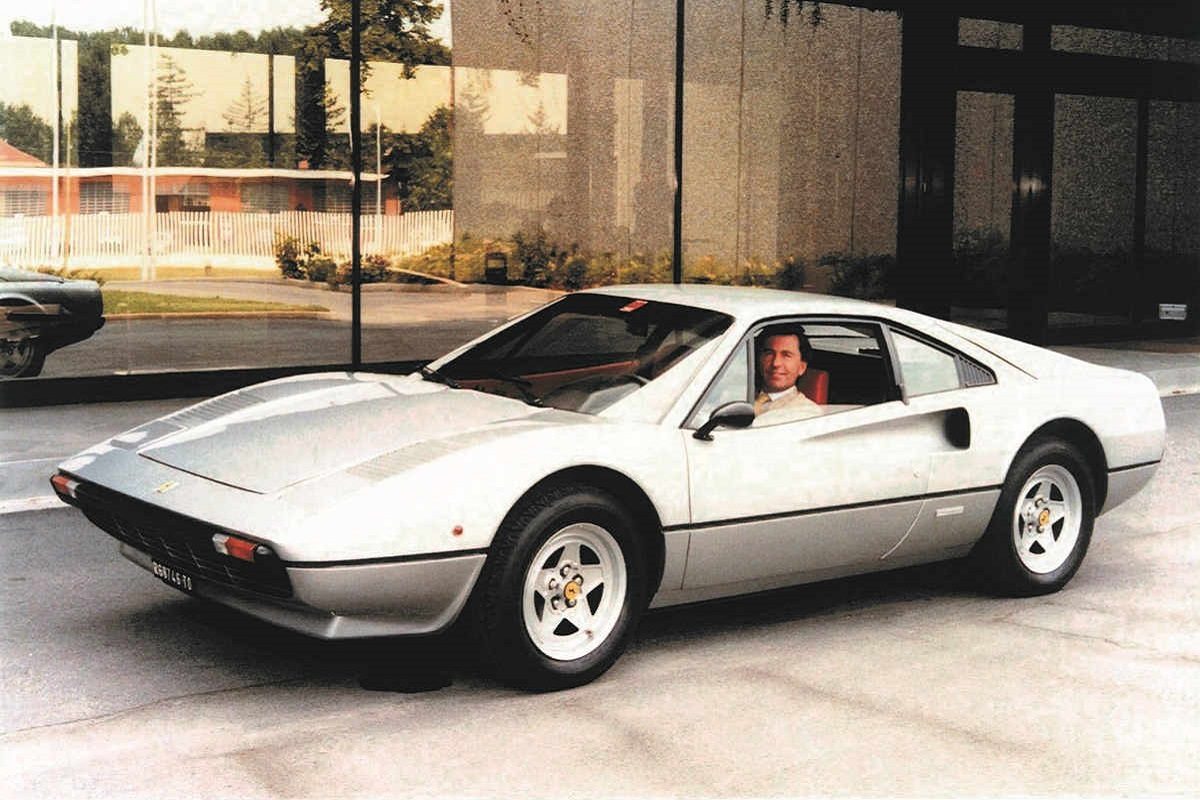
Fioravanti at the wheel of a 308 GTB — one of his own designs. The engineer as his own best test driver.
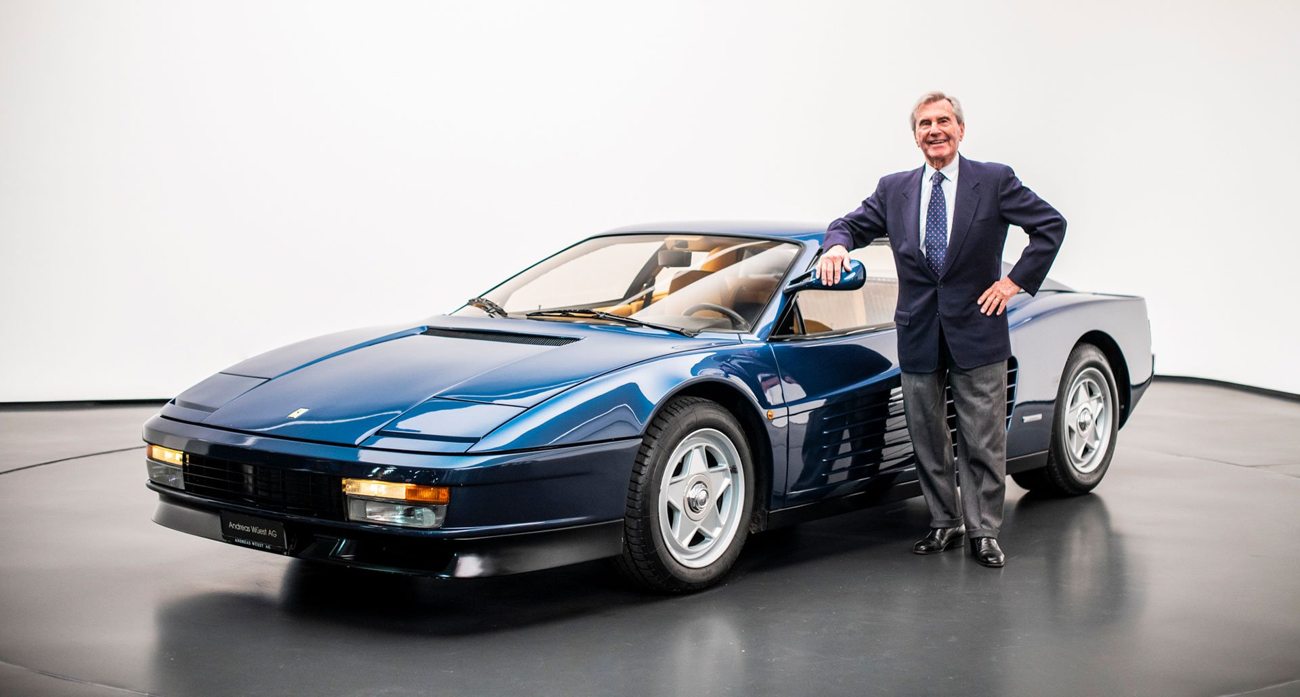
Decades later, beside a dark-blue Testarossa: the calm of a man whose signature shaped whole eras.
What he created reads like the history of the real Ferraris: the 365 GTB/4 Daytona (which he designed single-handedly, unbidden), the Dino 206/246, the Berlinetta Boxer, the 308, the 328, the 288 GTO — and finally the F40. And, for me the real point, the 365 GT4 2+2 — the direct father of my 400.
The austerity of the 400 is no exception in his work, it is the constant — even when the subject is sensual (Daytona) or brutal (288 GTO, F40). Add the Pinin, his four-door design, and outside Ferrari the Lancia Gamma and the Alfa 33/2 Coupé. A whole body of work, carried by a single attitude.
That is what struck me on that snowy car park without my being able to name it: not a car, but an attitude. An engineer who does not hide austerity but turns it into beauty. Forty years later I know why.
The Ferrari Brand — and Why the Dream Ends at 1.94 m
What makes a brand you feel in your own body. Sometimes quite literally.
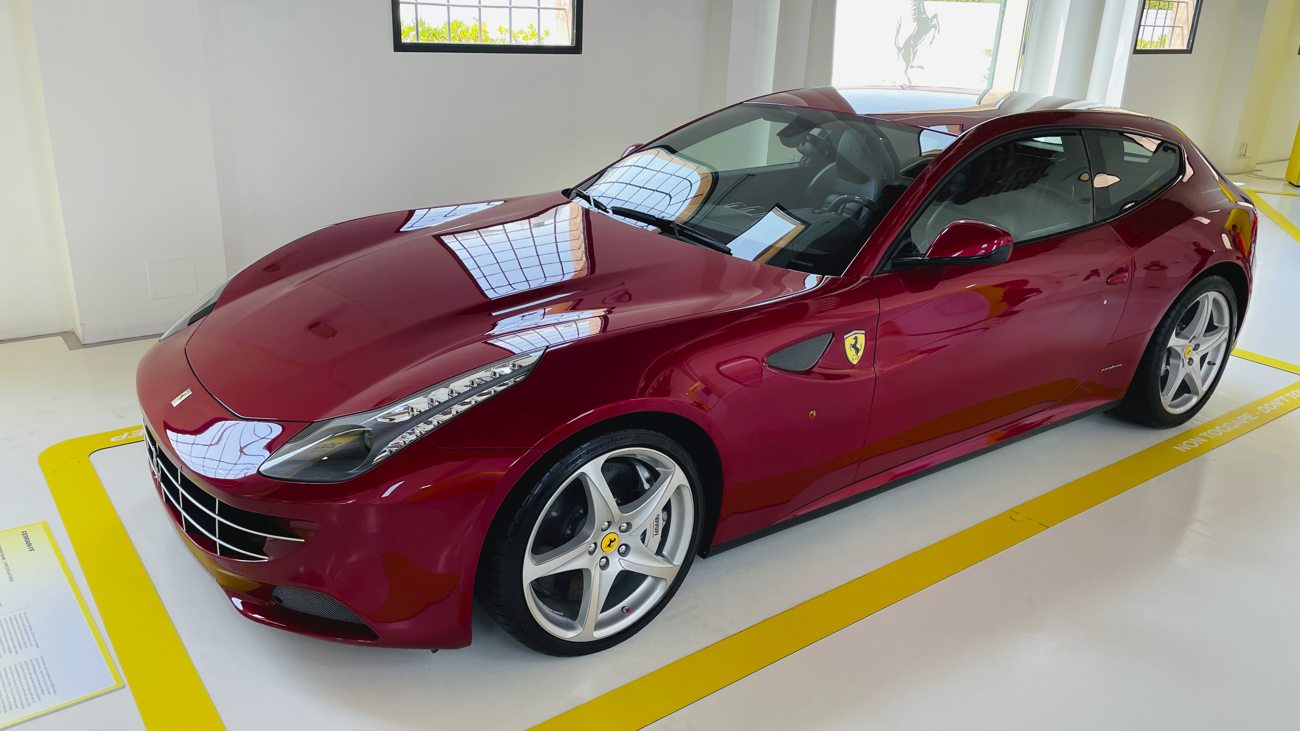
The Ferrari FF — one of the few with everyday usability and space. The exception that proves the rule.
The Iconic Dream — One Size Too Small
Hardly any brand sells longing as perfectly as Ferrari. Only the longing doesn’t always fit in the seat.
Hardly any brand in the world condenses a dream as completely as Ferrari: speed, beauty, status, Italian passion — all in one emblem. This brand identity has been woven so densely over seventy years that it feels almost physical. The trouble is: with me it actually becomes physical. I am 1.94 m tall, and the iconic sports car is simply one size too small for people of my height — but all the more beautiful for it.
A Test Sit as a Reality Check
When shoe size 48 meets mid-engine architecture.
When I was at the Ferrari dealer for a test sit and climb into a newer Roma, it’s already awkward to watch from outside. And once I’m in, my size-48 sneakers jam between clutch and brake. How am I supposed to declutch, brake and, if need be, accelerate to 320 km/h? Ducked behind the flat windscreen I could barely make out the traffic signs at the junction. And the seat won’t slide back any further — no seat rail, because mid-engine. That’s where the young-designer dream crashes onto the hard floor of reality.
What Makes the Brand — and What It Excludes
A brand is always also a decision about whom it is not made for.
This is exactly where it gets interesting for me as a communicator. What makes the brand? Ferrari sells not a means of transport but an uncompromising promise — and uncompromising also means: not for everyone, not for every build, not for everyday use. The tightness is not a design flaw, it is part of the brand identity. A Ferrari that was comfortable for a two-metre man would, in part, no longer be a Ferrari. The brand also defines itself through what it excludes.
And yet the question remains, half serious, half smiling: why are the Italians apparently so much smaller than the men north of the Alps? Perhaps that is exactly the point where admiration and belonging part ways — I admire this brand deeply, yet physically I do not belong to its target group. A lovely paradox: the longing stays unbroken precisely because it is unfulfillable. That, if you like, is brand management brought to perfection.