
I grew up with the HfG Ulm — not biographically, but aesthetically. The grid, the reduction, the ban on ornament: it sits deep in me, and I have never entirely shaken it off. All the more reason I have to ask the question no one in the field dares to: what, really, was there, between 1953 and 1968 on Ulm’s Kuhberg? A revolution in design — or a cherished legend, cultivated by a small intellectual elite that quotes one another?
The honest answer is uncomfortable for both camps: it was both.
A Moral Project, Not a Design Project
You don’t understand the HfG if you read it as a design school. It was first of all a moral project. Inge Scholl, sister of the murdered Scholl siblings, and Otl Aicher wanted, after 1945, nothing less than the intellectual re-founding of Germany — financed partly with American re-education funds and through the Geschwister-Scholl-Stiftung, established in 1950. Design was the vehicle, not the goal.
The thesis behind it: whoever democratizes the world of objects democratizes society. A tidy everyday life as the antithesis of völkisch kitsch. That explains the moralizing tone that still bothers me in many Ulm texts to this day — and that at the same time gives them their stakes. These people seriously believed that a radio housing is an ethical statement. You can smile at that. But you can also read it as what it was: an attempt to give a newly emerging discipline a theoretical foundation before the market degraded it into mere sales cosmetics.
The Core Ideas — in Four Sentences
First: design is not art but a scientifically grounded discipline — ergonomics, semiotics, sociology and mathematics were part of the curriculum. Second: what counts is not the single object but the system — modular kit, module, grid, series production. Third: form follows not taste but function and the manufacturing process. Fourth: the designer bears social responsibility for the industrial environment he helps create. This later called itself the “Ulm Model” — and it was the real innovation: not a chair, but a method.
Who Could Afford It?
The HfG was a milieu phenomenon: Protestant-inflected educated bourgeoisie, intellectuals eager for denazification, international scholarship holders, plus industrialists’ sons like Erwin Braun who bankrolled the whole thing as clients. You could study there if you could afford years of foundational teaching with no immediate payoff — in the economic-miracle republic, a tiny minority. The HfG debated the correct coffee pot while the country bought kidney-shaped tables. This gap between ambition and reach is the core of the legend-making: a small circle produced enormous discursive stakes, and stakes create myth.
Fifteen Years — and Fifty Years of Resonance
Founding, conflicts, dissolution — and the works that outlived the institution.
The TC 100 Test: Is Stacking Tableware Worth a Legend?
Take the hardest case: Nick Roericht’s TC 100 of 1959. A diploma student designs stackable system tableware for canteens — modular, functional, space-saving, standardized. Groundbreaking? From today’s vantage it looks like a self-evident thing no one should need to write a dissertation about. But that is exactly the fallacy of hindsight: in 1959, the idea of thinking of tableware not as a decorated service but as a logistical system — from the washing cycle to storage height to the breakage rate — was genuinely new.
The TC 100 was mass-produced by Rosenthal/Thomas, stood for decades in canteens and flew with Lufthansa. It worked, in the most literal sense. Does anyone still care after more than fifty years? The honest answer: outside design museums and seminars, hardly. But the question is wrongly posed. No one cares about the first standardized part of a screw connection — and yet it holds our world together.
The legend is not about the plate. It is about the proof that everyday life can be designed as a system.
Institution or Individuals? An Uncomfortable Inventory
And so to the central question: was the HfG a brilliant institution — or merely the accidental address of a few extraordinary individuals? My thesis, after many years with the subject: the institution was weaker than the myth claims, and the individuals were stronger than the institutional history admits. You see it when you go through the biographies one by one — and when, as in the chart above, you line up the numbers of units actually produced.
Bill and Gugelot: Really So Thin?
The provocation that the output of Bill and Gugelot was “relatively thin” I consider only half justified. With Gugelot the work-list arithmetic holds — but the M125, the SK 4 and the Carousel projector are three systemic designs, each of which defined an entire product category, and he died at 45. That is not a thin oeuvre, it is an interrupted one. With Bill the finding is almost the reverse: a failure as rector and ideologue, he created, with the Junghans watches, of all things the most durable commercial product of the entire Ulm sphere — you can buy it new in 2026. Few models, yes. But which designer has a product in the range that is still sold unchanged after 65 years?
The Engler Case — Zeitgeist Without a School
And then there is a name that appears in no Ulm chronicle and turns the whole question of institutions on its head: Heinz H. Engler. He lived and worked in Biberach, less than forty kilometres from Ulm — and with the “B 1100” system tableware for Bauscher he designed the world’s best-selling hotel porcelain, in unchanged production since 1962, plus the glassware series for Stölzle. Stackable, break-resistant, radically reduced: the purest Ulm spirit. Only Engler was never at the HfG. He didn’t even have a university degree — a trained potter, a technical college for ceramics, self-taught all the way to a professorship. In the bar chart above, of all bars, his rises highest — that of an outsider.
This leads to the heretical question: what, back then, was actually Zeitgeist — and what was the HfG? Perhaps “gute Form” was in the air anyway, and the school was not its source but its loudest amplifier. Engler proves that one could have the Ulm idea without Ulm — perhaps even more effectively, because closer to the factory than to the seminar.
It is the same observation that recurs today in Silicon Valley: Sam Altman dropped out of Stanford, Elon Musk left his doctoral programme there after two days. The defining figures of an upheaval are often not the model students of the relevant institution, but those who smelled the Zeitgeist earlier than their syllabuses did. Institutions ennoble ideas — but they rarely invent them alone. That is precisely the uncomfortable punchline of the whole Ulm legend.
Rams and Sapper — Two Global Careers, Trained Far from Ulm
Engler is the extreme case, but he does not stand alone. Of all people, the two names the broad public associates most firmly with “Ulm” and “gute Form” — Dieter Rams and Richard Sapper — never saw the HfG from the inside as students. Both nonetheless became synonyms for exactly what was preached on the Kuhberg. Their biographies confirm the Zeitgeist thesis twice over — and then take it further, because the same slogan, form follows function, meant something thoroughly different to each of them.
Dieter Rams — The Discipline of Leaving Out
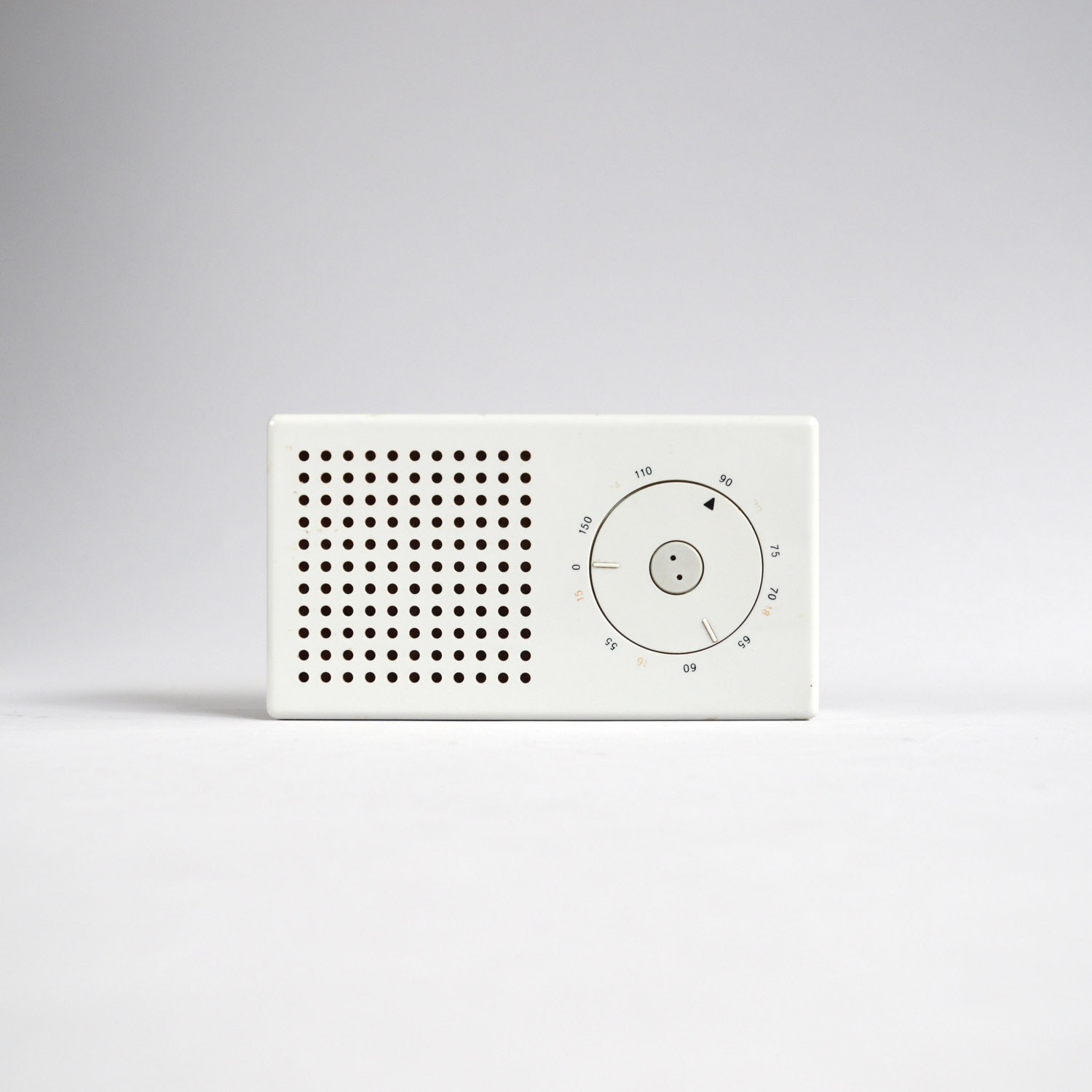
Born in Wiesbaden in 1932, Rams grew up around the joiner’s trade and even interrupted his studies for a carpentry apprenticeship — the honesty of materials that carries his whole body of work he learned literally at the workbench, not in a seminar. He studied architecture and interior design from 1947 to 1953 at the Werkkunstschule Wiesbaden, which he himself called a “little Bauhaus”; he graduated with distinction. Then two years with the Frankfurt architect Otto Apel, before the Braun brothers hired him in 1955 — not as a designer but as an architect and interior designer for the expansion of the works.
His only real Ulm connection, then, was not an institution but a person: Hans Gugelot, at whose side the SK 4 radio-phonograph combination emerged in 1956. Rams never attended a single lecture at the school — he worked out the Ulm puritanism for himself and then, via Gugelot, met it halfway. From 1961 to 1995 he headed design at Braun; from 1981 he taught in Hamburg.
Rams’s reading of form follows function is Protestant, north-German, self-effacing: “Less, but better.” Or, more sharply: “Good design is as little design as possible.” For him function is served by removing everything that is not function — ornament is not a harmless addition but a small dishonesty. The device should recede, not show off; good design behaves like a discreet English butler you notice only when you need him. His ten principles have long been Silicon Valley catechism.
Richard Sapper — Function as Spectacle
Sapper too — born in Munich in 1932, died in Milan in 2015 — never attended a design school, let alone the HfG. Raised in Stuttgart, he studied a positively daring mixture at the University of Munich: philosophy, anatomy, engineering and graphics, completed with a degree in economics. He spent his first working years not at the drawing board of an academy but in the styling department of Daimler-Benz in Stuttgart — reportedly working on the wing mirror of the 300 SL.
In 1958 he moved to Milan, worked with Gio Ponti and in the development office of the department-store chain La Rinascente, before the roughly two-decade partnership with Marco Zanuso began. From it came the Brionvega icons — the fold-open TS 502 radio, the Doney and Algol televisions — and the Grillo telephone. Solo works followed: the Tizio (Artemide, 1972), the 9090 espresso maker and the 9091 kettle for Alessi, and from 1992 the ThinkPad series for IBM. He won the Compasso d’Oro eleven times; he ran his own studio from Stuttgart.

Both devices owe themselves to the same technical caesura: only the transistor made the heavy tube boxes small and cool enough to become objects one carries, tilts or folds open. Zanuso and Sapper used that freedom to give each appliance an unmistakable shape. They pushed it furthest with the radio: at rest the TS 502 looks nothing like a radio, but like a glossy cube with a chrome handle that reveals itself only when you open it up.

Sapper’s form follows function is as anti-ornament and rigorous as Rams’s — and yet its exact opposite in temperament. Where Rams conceals the mechanism, Sapper stages it. The Tizio demonstrates it: the transformer sits in the base, the low-voltage current runs through the metal arms themselves — hence not a single cable — and the counterweights that hold the cantilever weightless in space remain visible as the whole visual drama. Here function is not hidden but turned into a stage — with wit and a moment of surprise. German engineering precision plus Italian sensuousness: function is allowed to be beautiful, even theatrical.
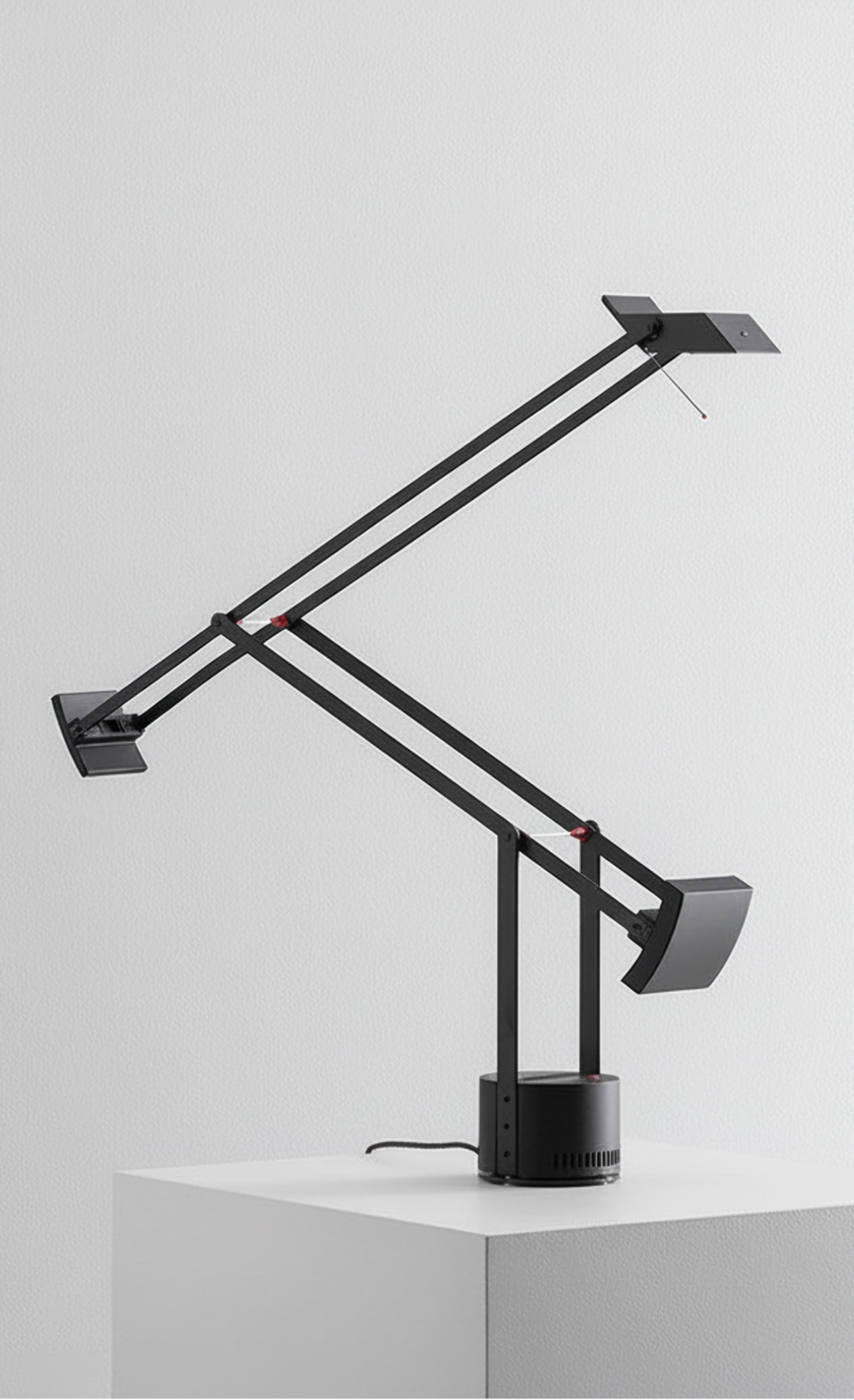
So two icons stand opposed, sailing under the same flag yet heading in opposite directions. Rams removes until only function remains and the object all but disappears; Sapper exposes function until it becomes spectacle. The one wants to be a good servant, the other a magician. Ulm preached the one correct form — these two prove there were at least two, both coherent, both defensible, and neither taught on the Kuhberg. The Zeitgeist simply had more than one antenna: one in Wiesbaden and Kronberg, one in Munich and Milan. The HfG was the loudest — but by no means the only one.
What Really Resonates — and What Was Hot Air
Let us take sober stock. Hot air was: the claim to make design fully scientific. The faith in method that, in Ulm’s final years, smothered every joy in designing. The moral claim to sole representation that declared every decorated plate a civilizational relapse. And a good part of the subsequent legend-tending — carried out by graduates who musealized their own biographies.
Substance was: the systems thinking that today sits in every design system, every modular kit, every component library. Corporate identity as a discipline — Aicher’s invention, without which neither brand management nor my own working life in B2B communication would exist as they do. The design methodology of Maldonado and Bonsiepe, which by detours became today’s UX education. The grid system in visual communication. And the Braun design language that migrated, via Rams, straight into the iPhone — perhaps the greatest quiet takeover in design history.
Ulm Against the Earthquake
And then the comparison that has pressed itself on me for months: against what today’s AI models are unleashing, the Ulm debates look like a quarrel over the curvature of a saucer. That is true — and it is not. The AI revolution is an earthquake that shakes society into its last corners; the HfG was at best a local tremor of magnitude three. But the question posed on the Kuhberg is exactly the question of today: how do you design a new, powerful technology so that it serves people and not the other way round? Who bears responsibility for the systems they release into the world?
The Ulm people had too small an object for it — toasters instead of transformers — but the right attitude. That today we argue about “alignment” the way Ulm argued in 1958 about the correct method, complete with moralizing, sect-building and rectorship crises, is an irony Maldonado would have enjoyed.
My Conclusion: A Legend, Yes — but a Deserved One
The HfG Ulm was overrated as an institution and is underrated as an impulse. Fifteen years, permanently underfunded, riven by conflict, finally wound up by a state parliament that could make nothing of its ambition. Measured against its own world-improving rhetoric: a failure. Measured against what a handful of people in a concrete building on a hill above Ulm put into the world — a discipline, a method, a visual identity for the Federal Republic, and by detours the design language of the very devices on which this text is read —: astonishingly successful.
So I stand by my sympathetic-critical stance. You need not believe the legend to use the legacy. As I write this text I sit at a grid, in a reduced typography, with a single accent colour — and I know exactly where that comes from.