
This piece will be uncomfortable. Not because I don’t value you – but because I’ve valued you for more than three decades, and so I’ll stop tiptoeing politely around it. You build world-class products. And you leave them hidden. Let’s start with the scene I know by heart in your industry.

Ten agencies, ten months, zero results
A machine builder, over a billion euros in revenue, world-class engineering. The order from the executive floor: we need a campaign. Emotional. Modern. Bold. We finally want to be visible.
What happens next, I know by heart: ten agencies invited. Briefings. Review meetings. A shortlist. Two more pitch rounds with the best. Meetings, meetings, meetings. After ten months, the result: nothing. The reason given: “That’s not us. We’d rather do nothing.”

The agency frustrated. The two or three marketing people back in other meetings. And the technically brilliant management: left alone and at a loss.
What it was not about: not the agency, not the budget, not a lack of courage. What it was about: the decision-making process itself. You procured marketing like a component – with a specification sheet, an approval loop, consensus in the steering committee. But a brand isn’t born in an approval loop. It’s born from a stance that has to exist beforehand.
Whoever doesn’t know who they are can’t write a brief. They can only pay ten agencies to find out – and then reject every answer.
Pride in engineering is no marketing strategy

This is no reproach. It’s structural. Whoever runs a machine-building company of this size almost always came up through engineering. Deep engineering competence. The ability to answer a Tier-1 customer’s requirement one-to-one – from tolerance through production to the payment term on the invoice, often on the leash of the industry sitting in front of you. That very ability carried the company for twenty-five years.
The problem: they are exactly the same skills as twenty-five years ago. And today’s market is not the market of back then.
Engineering excellence answers the question: how do we fulfil a specification perfectly? Marketing answers a different one: why should anyone know us before they even send a specification? For the first question you have a proven repertoire. For the second, you don’t. That’s why, when markets shift, the reflex kicks in that always worked: manufacture even better, deliver even more precisely. Only this time that reflex doesn’t carry. No wonder a management team with such high technical expertise has no proven repertoire for economic upheavals – it never had to fail in this field.
The concentration risk you call customer loyalty
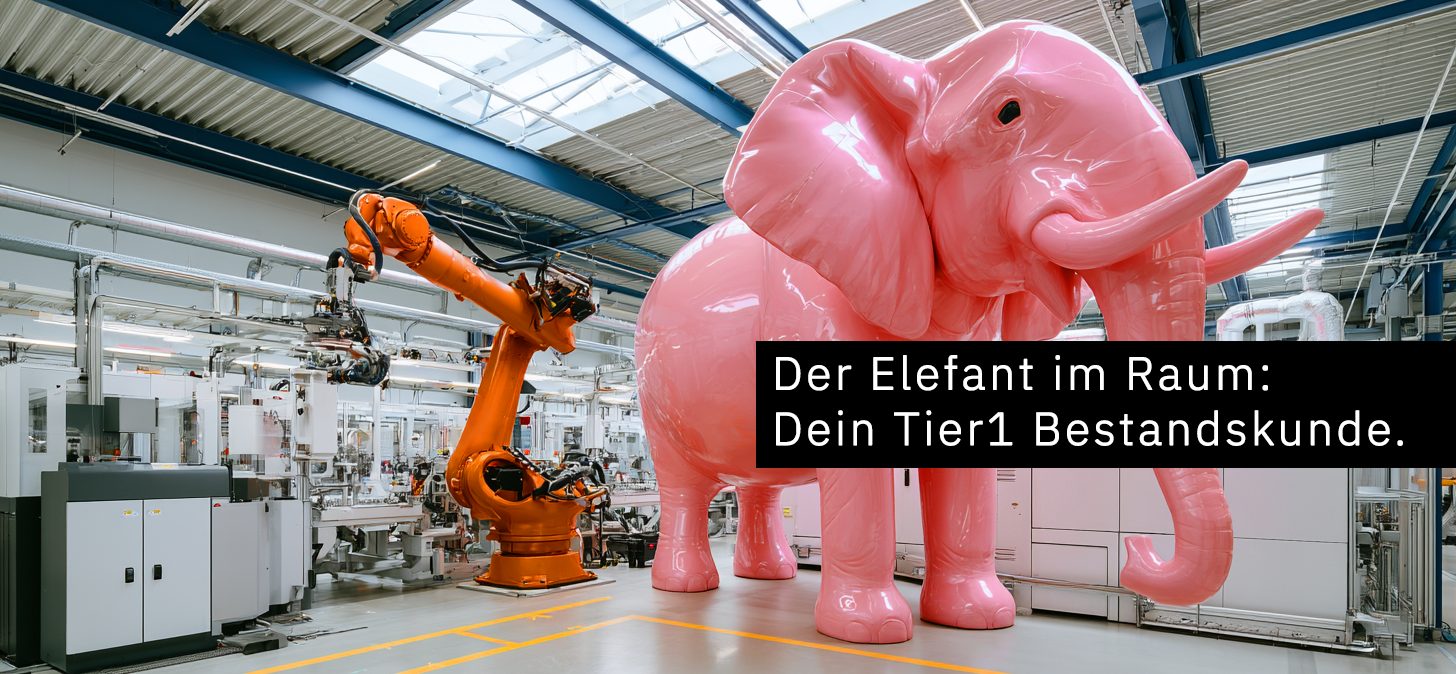
When I talk about visibility, the sentence comes almost reflexively: “Why? The five or six OEMs that matter to us have known us for twenty years.” True. And that very lens is the risk.
You sit on the leash of the industry in front of you. It dictates prices, deadlines, payment terms, often half the process chain. As long as their demand runs, your shop runs. If it collapses – and it’s collapsing by double digits right now – you are existentially vulnerable. Not because of poor technology. Because of missing alternatives. A handful of customers is not a sales success. It’s a concentration risk.
And with every campaign idea the same sentence falls: “What will the five say when they see this?” That’s the wrong question. You optimise communication for people who have long known you – instead of for the thousand who should know you but have never heard of you. Visibility isn’t a marketing luxury for you. It’s risk management.
Marketing as a mailroom

Let’s look honestly at your marketing department. Two, at most three younger staff. Their day:
- Building PowerPoint slides.
- Booking the same trade-fair stands at the same fairs every year.
- Ordering promotional giveaways.
- Publishing a press release three times a year.
This is no criticism of these people. They do, with commitment, what is asked of them. It’s a criticism of what you call marketing. Because you confuse marketing activity with marketing impact. Trade-fair stand, flyer, giveaway – that’s logistics. Execution. A cost centre. It moves no brand; it merely keeps the status quo running.
That’s why this department can’t deliver a campaign ordered from the executive floor either. Not out of incompetence – but because you never set it up, equipped it or mandated it to. Marketing that gets heard in the market is not busywork for two working students with InDesign. It needs a mandate that reports directly to top management; people who are allowed to think strategically, not just execute; and a budget you run as an investment, not as a line item you cut first in a downturn. Whoever treats marketing like a mailroom gets the impact of a mailroom.
“That’s not us.” – Fine. Then who are you?

It’s the sentence at which most campaigns in mechanical engineering die. After ten months of pitching, just before implementation: “No. That’s not us.” And then? Nothing happens. Better nothing than something wrong.
So the uncomfortable counter-question: if you can say so confidently what you are not – then please tell me in one sentence. Without product data, without certificates, without “leading in”: who are you? With most, it goes quiet at this point.
That’s exactly the core. You reject every answer because you have none yourselves. “That’s not us” is not a quality verdict. It’s the admission that an identity is missing – one against which proposals could even be measured. An agency can’t tell you who you are. It can only make it visible – if it’s there. If it isn’t there, every draft becomes a guessing game that you reject in the end. Ten months, burned on a question you should have settled beforehand.
Clarify what you stand for. Not what you can do – what you stand for. What would be left of you if you removed all the data sheets?
This answer is not a marketing task. It’s a matter for the boss. And it’s the precondition for everything that comes after.
You don’t fail at the task. You fail at your processes.

This is the most important insight of this piece – and the most uncomfortable. You run a company with over a billion euros in revenue. You master highly complex processes: production control, supply chains, quality assurance to the micrometre. You are no beginners at complexity.
So why does the marketing fail? Not because the task is too hard. But because processes and decision-making in marketing run completely differently from anything you know.
In production the rule is: define, specify, approve, execute. A linear, safeguardable path. Zero fault tolerance. Marketing works exactly the other way round: iterative, hypothesis-driven, with calculated risk and the willingness to learn in the market instead of safeguarding everything in advance. A brand isn’t approved. It’s developed, sent out, adjusted. Whoever applies the first process to the second field produces exactly what I see everywhere: ten months of safeguarding, zero results.
And there’s a bitter irony in these processes. For decades your existing customers ordered from you, pushed the price down, dictated the path and the strategy – you sat on the leash. Yet the moment you become the client yourselves, in marketing, at the agency pitch, you do exactly the same: you treat your marketing experts the way you were treated as a supplier. 180 days’ payment terms, price pressure, scope selection, round after round. You reproduce the very leash logic you suffer under – and then wonder why nothing new becomes visible in the end.
Change your marketing processes, and your results will change.
You don’t have to adopt marketing’s skills. You have to adopt its decision logic: decide from a clear stance, not from consensus in the steering committee. Accept that the first version is never “finished” but the start of a learning process. Give an idea the chance to work in the market instead of scrutinising it to death internally. The problem was never the difficult task. It was the unfamiliar processes behind it. Here – right here – the opportunities are waiting.
And now the good news

So much for the diagnosis. Now the good news – unvarnished. The way you’re doing it now won’t work. Your current decision-making and idea-finding processes are not fit for statements that get heard in the market. They are built for precision, not for relevance.
And no: it does not matter that the well-known five automotive firms already know you. It does not matter what they might say when they see your new campaign. That’s not the point. Take off those glasses. Look at your own shop from the outside, with real distance.
You have the substance. You just don’t show it.

What you’ll see then: a company with real substance – technology, trust, often niche world market leadership – that leaves its greatest strength hidden. Not out of inability. Out of habit. And that’s the best news in years: because your problem is solvable. It doesn’t lie in missing substance – you have that. It lies in processes and mindsets. And those can be changed.
Marketing, brand development and awareness are becoming hard success factors. Not ornament – economic factors. Whoever carries on as in the last twenty years will miss the new targets by design. Whoever takes off the glasses will find opportunities that have lain unused for years.
Audi vs. Subaru: the costliest marketing lesson in automotive history
If you take only one thing from this piece, take this story. It’s also what sits behind the chart at the top.
“Vorsprung durch Technik” – Audi’s quattro all-wheel drive was, for decades, the communication leadership for all-wheel-drive cars. The term, the image, the interpretive authority: when you thought of all-wheel drive, you thought of Audi.
But the technology leadership lay elsewhere over those same decades: with Subaru. The long relatively unknown “forester’s car”. Because, honestly, real all-wheel drive is only truly needed in open terrain – in the woods, on the field, off-road. Everything else was a marketing invention by Audi. And a damned good one.

The punchline: over the years Subaru built far more all-wheel-drive vehicles than Audi – the real volume of the technology lay with the “forester’s car”. But Audi’s marketing used the feature intelligently and shaped from it a brand that succeeded for decades. So a technical feature became a benefit of the brand. Very clever.
Subaru had the better story in the sheet metal. Audi had the better story in the customer’s mind. And markets are decided in the customer’s mind.
Now look at the chart: Subaru sits bottom right – technology leader, invisible for decades. Audi sits at the top – communication leader. And German mechanical engineering? It sits bottom right, right next to Subaru. Outstanding technology, and hardly anyone knows.
The picture held for three decades. Not anymore.
This picture held for about three decades. Today the view of it is a different one – and that’s exactly what completes the lesson. Subaru never really established itself as a brand; superior technology alone never closed the gap in perception. And Audi? After the decades-long ascent comes a hard landing. The promise “Vorsprung durch Technik” no longer carries the way it used to.
Why is many-layered. But one thing is clear from a marketing point of view: the positioning was no longer filled with life. No longer with exciting stories, no longer with sharp statements. A brand promise is not a monument you erect once – it’s a fire you have to keep feeding. When the storytelling stops, the leadership goes cold too.
Technical superiority isn’t enough. And neither is interpretive authority once won, if no one keeps telling the story.
What this means for you
For you there’s a real punchline in this – in both directions. The uncomfortable one: communication leadership is never “finished”, not even once you’ve reached it. The encouraging one: Audi had to invent its story – the claim that you need all-wheel drive everywhere. You have to invent nothing. Your product is genuinely needed. You already have in the house the substance around which Audi had to build its story back then. Filling a positioning with life on real substance is far easier than keeping a marketing claim burning for years – provided you decide to tell it at all.
The gulf between workbench and market is real. But it’s no law of nature. It’s a decision. Yours.
So let’s go – here are the three steps

Dear managing directors, think for a moment about these three steps. They cost you no cultural revolution – just a different stance:
1 At most three agencies. Not ten. Ten applicants are no proof of quality; they’re a symptom of a missing prior decision. Whoever knows beforehand what they stand for needs no casting show.
2 At most one pitch round. One. The second and third round don’t make the proposals better – only you more insecure. After that, you decide: from a stance, not from exhaustion.
3 Treat the brand as a process, not a project. Get used to the idea that a brand view is at first an assumption – a hypothesis you test and sharpen in practice. Not a “one shot” where everything has to land at once. But a continuous improvement process, round after round.
And now the point where this should feel familiar. Because this is exactly how you pulled off the hardest optimisations in your history.
Dear technical managing directors: make this story work for you. In marketing and positioning, think one turn further around the corner than your competitors.

Remember Porsche. In the early nineties the company stood at the edge – sales had collapsed from around 50,000 to about 14,000 vehicles. Wendelin Wiedeking turned it around not with one big shot but with continuous improvement: Kaizen rounds on the Japanese model, for which he brought the Shingijutsu consultants from Toyota to Zuffenhausen. Famous is the scene in which he cut the over-high storage shelves down to half height with an angle grinder, in front of the workforce – not PowerPoint, but starting. Week after week, detail after detail. Out of this process came one of the most profitable carmakers in the world – a success that carried well into the 2000s.
From the shop floor to marketing
And here’s the decisive part: later that very Kaizen migrated from the workbench into knowledge work – from the line into the whole company. That’s the step I mean. Transfer the method you master in your sleep on the shop floor to your marketing. A brand view as an assumption, a lean implementation, then measure, learn, sharpen. There’s no risk of a ten-month failure if you never wait ten months for “finished”. You start – and get better with every round.
This is no foreign art. It’s your craft – applied to a new field.
Take off the glasses. Think in continuous improvement, not in campaign. And then: start. Committed, as a continuous improvement process, and with a development time you know from your best products. It’s about years. Not weeks.

- In mechanical engineering, marketing rarely fails at the task – almost always at processes and decision logic built for production, not for market relevance.
- Technical managing directors have no proven repertoire for market upheavals because they never had to fail in this field. That’s structural, not a character flaw.
- A handful of well-known OEM customers is a concentration risk, not a sales success. Visibility beyond the existing base is risk management.
- The sentence “that’s not us” exposes a missing brand identity. Whoever can’t say what they stand for can’t judge a brief.
- Technology leadership doesn’t automatically become market leadership. Communication leadership must be built deliberately – and kept alive with stories. Audi and Subaru show both sides.
- The way there is continuous improvement, not campaign: at most three agencies, one pitch round, a brand view as an assumption and iterative implementation – the same process logic with which Porsche achieved its turnaround under Wiedeking.
Why does mechanical engineering struggle so much with marketing?
Because technical managing directors rose through production and draw their self-worth from engineering achievement. Marketing follows a different logic – iterative, hypothesis-driven, not linearly safeguardable. It rarely fails at the task, mostly at unfamiliar decision-making processes.
Is marketing necessary in B2B mechanical engineering if customers already know us?
Yes. A handful of known customers is not a sales success but a concentration risk. If the demand of the few OEMs collapses, alternatives are missing. Visibility beyond the existing customer base is therefore less a marketing luxury than risk management.
Why do marketing campaigns in mechanical engineering often fail after the pitch?
Because marketing is procured like a component: specification sheet, pitch, approval loop. In the end comes the sentence “that’s not us” – and nothing happens. The real deficit is a missing brand identity against which proposals could even be measured.
What is the difference between technology and communication leadership?
Technology leadership is won on the shop floor – through better products. Communication leadership is won in the market – through visibility, positioning and interpretive authority. The two are independent: you can lead technologically and still be invisible.
What can machine builders learn from Audi and Subaru?
Subaru was the all-wheel-drive technology leader for decades but remained unknown as a brand. Audi captured communication leadership with “quattro” and “Vorsprung durch Technik” – partly through a marketing narrative. The model held for about three decades. Today it no longer holds: Subaru never broke through, Audi is experiencing a hard landing after its ascent because the positioning was no longer filled with stories. The lesson: communication leadership must be built deliberately and kept alive.
How should a machine builder set up a marketing campaign?
Not as a ten-agency casting with several pitch rounds. Better: at most three agencies, at most one pitch round – and implementation as a continuous improvement process instead of one big shot. The brand view is an assumption you test and sharpen iteratively: start, measure, learn, sharpen – the same Kaizen logic that carried the Porsche turnaround under Wendelin Wiedeking.